
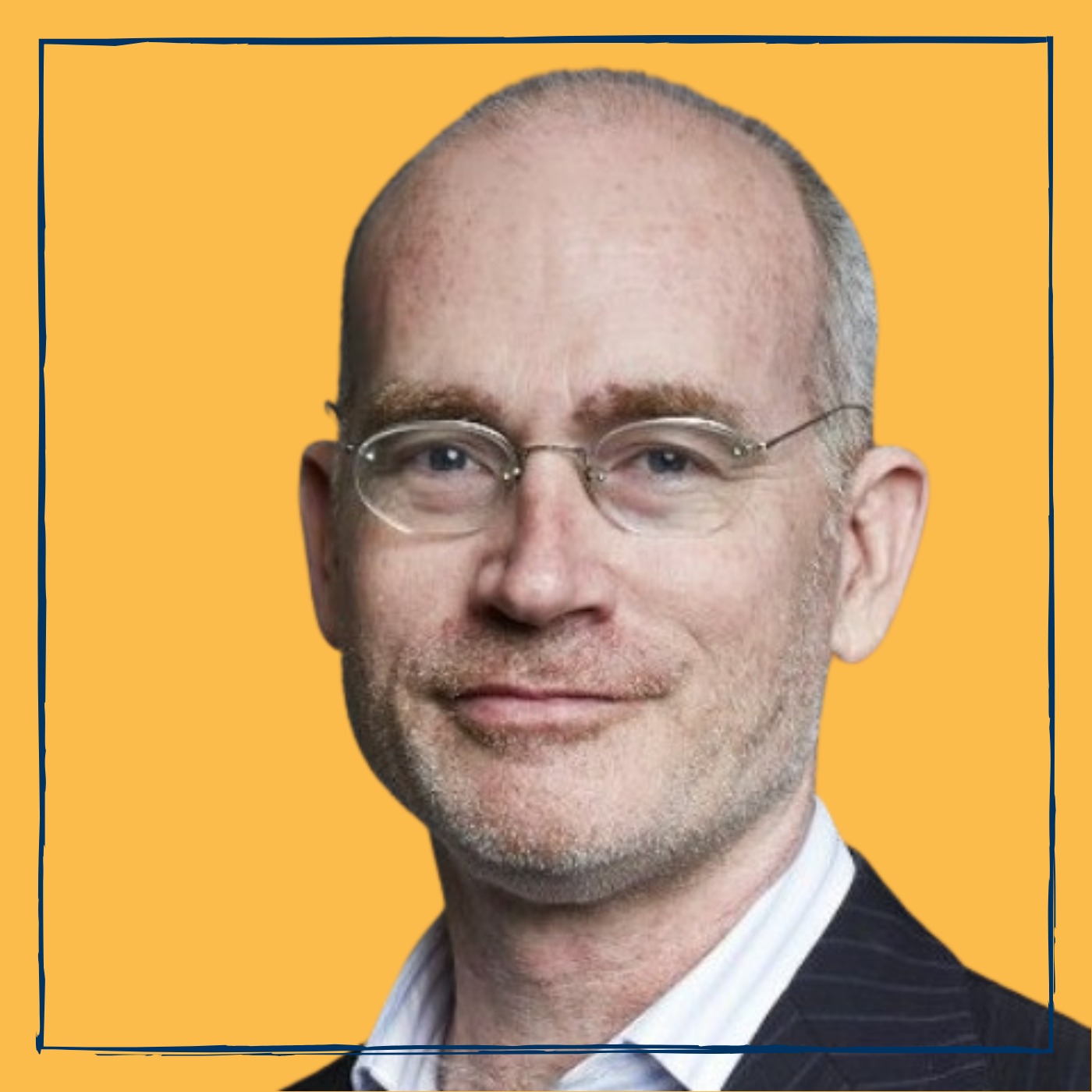
"Professor Series" Part 2: Interdisciplinary Thinking, Innovation, and the Future of AI — A Conversation with Professor Greg LaBlanc
with Professor Greg LaBlanc
"Professor Series" Part 2: Interdisciplinary Thinking, Innovation, and the Future of AI — A Conversation with Professor Greg LaBlanc
0:00 / --:--In this episode of Here@Haas, Michele and Vance kick off a new faculty series with one of Haas’ most celebrated educators: Distinguished Teaching Fellow Greg LaBlanc. Known for his dynamic classes on strategy, game theory, and behavioral finance, and for his influential podcast, unSILOed, Greg shares how an early Montessori education shaped his interdisciplinary curiosity, the unconventional academic path that led him to Berkeley, and why he believes the future belongs to those who can integrate ideas across fields.
Together, they explore innovation, entrepreneurship, competitive moats in the AI era, the role of proprietary data, and why enduring success often requires “fixing things before they break.” Greg also discusses character as life’s true project, the importance of long-term learning, and the deep alumni connections that enrich his life far beyond the classroom.
This episode offers insights for anyone considering strategy, disruption, and building a meaningful career in a rapidly changing world.
Episode Quotes:
If it ain’t broke, fix it anyway!
I see Haas as ambassadors for this vision. We go out into the world and populate these companies with this unique view of the importance of innovation, the importance of rethinking. I mean, why is questioning the status quo the first of our defining principles? It's because if you don't question the status quo, status quo will crush you. And so one of the things that I always like to say is an implicit slogan of Haasies is if it ain't broke, fix it anyway. It is gonna be broke if you don't do anything. And so being capable of anticipating the future, of being open to being wrong, being open to continuous reinvention, that's what I love about being here.
On what he is most proud of in his life
It has nothing to do with worldly accomplishments. It has to do with character development. So, not to say that I've got this wonderful, great character. I mean, there's tons of room for improvement, but I think at the end of the day, the only thing that you have control over in your life is your character: the way you act, the way you think, the way you behave, the way you treat other people, and your approach to the world.
On playing the long game
There are people who just think they have forever to do stuff, and then there are other folks who think that they have to do everything right away. And so I would say play the long game. Understand that you might live fairly long period of time and, you know, you might not. Right? And so, learn like you're gonna live forever, really focus on learning without any necessarily obvious reason to think that what you're learning is gonna be immediately valuable. You'll find that things that you learn at one point in your life turn out to be much valuable later in life, oftentimes in unexpected ways. So, focus on learning with a long-term perspective.
Why good MBAs are good generalists
To be a good generalist is to have this very active mental switchboard that sends you off in all sorts of directions, makes connections that other people don't see, thinks analogously, and sometimes metaphorically, right? Scientists often think in very linear, very structured ways. Start with small building blocks, work up to more sophisticated things. I think the superpower of a good MBA is that you don't limit yourself to that way of thinking, but that you have all these combinations, these neural combinations that send you in different directions.
Show Links
- Greg LaBlanc – LinkedIn
- unSILOed Podcast
Transcript
Auto-generated from audio — may contain errors. Always trust the episode itself.
What's up, everybody? My name is Van Seabert.
And my name is Michelle Overmire. You're listening to Here at Hoss.
This is a student-led podcast taking you through all things, Hoss related, students, faculty, professors, you name it.
So let's jump into what's happening here at Hoss. Welcome everyone and thank you for tuning in to Here at Hoss. Today, Vance and I are excited to kick off a brand new series where we interview our favorite professors on campus. Today, I have the great pleasure of introducing one of our distinguished teaching fellows at Hoss School of Business, who instructs a variety of courses including strategy, game theory, and behavioral finance.
He is an academic fellow of the Suitarges Center for Entrepreneurship and Technology, a host of his own podcast on Cylode, an industry strategic consultant, and a mentor and role model for so many of us. I probably did not capture everything there, but we are very excited to have you on Professor Greg LeBlanc. Welcome.
Excellent. Glad to be here. Yeah, I know we're really excited to have you on and so are listeners. So let's jump right in. I want to take us through maybe three core buckets today. Professor, I want to start with your journey, and what sort of led you to where you are today. In class, I've heard you say many things that make it very evident that you are well educated in various topics. Can you start with your background and your education and where you thought that might take you and where it did end up taking you?
Well, I don't know why I should start. Maybe I should start when I was like super young. I went to a Montessori school. And for those people who have been to Montessori school, which apparently include people like Steve Jobs and Jeff Bezos and Sergey and Larry and all those folks. It's basically all about teaching kids how to teach themselves, teaching kids to be curious, teaching them to be in charge of their educational journey and that kind of shaped me.
And so by the time I got to university, I refused to buy into any of the programs that they were offering me and so I wound up taking classes and all sorts of different disciplines and so at the end of a couple of years I was like oh well let's see what majors they fit into and so I majored in in history and politics philosophy economics and business just happened away and then when I went to grad school I kind of wanted to continue that journey of doing lots and lots of different things and in grad school, that's not usually acceptable.
So I got into a lot of fights in grad school to try and continue to be broad instead of deep. And so in business school, it's actually possible for you to be broad and not as deep, but in academia, it's very difficult. So my academic journey was a little bit circuitous. but I just kept persisting and then ultimately wound up here at a cow after spending some time at teaching at Wharton and Duke and Virginia in a couple other places and I've been here ever since.
So what made you come to Berkeley specifically? Was it something in the water or the eat that's listed around it?
I'll tell you what made me come as different from what made me stay. So I came here to do an LLM in the law school. Thinking I was going to go right back to University of Virginia where I was. But, high school came along and said, I want to just stay. And so, in order to pay for my law school, I was at GSI. And I got the GSI award and they said, hey, why don't you stick around and start teaching? And so, the rest is history I've been here ever since.
Was there something along all the studies that particularly shaped your interest in strategy or any of the other topics that you currently teach today?
Yeah, I mean, all of these topics that I teach are interdisciplinary, right? In fact, the premise for my podcast is I want to promote interdisciplinary. research, right? So again, there's broad and deep. And so you can go really, really deep into certain disciplines and domains. And then you can also spend your time stitching together, things from different domains. And so that's kind of the theme that's run through my entire career as, you know, I did economic history and I did law and economics and I did psychology and biology. And so strategy in particular is is highly interdisciplinary.
It is something which requires a way of thinking that goes beyond inductive and deductive. Utilizes what's called abductive reasoning. I just did a podcast this morning with a computer scientist on education. What makes humans unique and what makes humans unique is this capacity to make inferences about things you've never seen before, right? And to add theories, you don't need to learn from experience.
Yeah, I know. I follow you on LinkedIn where we are connected. And I know you post a lot about entrepreneurship and how that kind of is intertwined with the culture around Berkeley. How would you say strategy ties in to running or founding a successful startup? Obviously, you need some strategy to figure out what you're going to be doing in and why.
Yeah, no, so strategy is different from, say, operations in the sense that you are trying to deal with a world that doesn't exist yet. So if you're doing an operational problem, then you have all this data, you have all this information, you can optimize, right? The past is your training data and then, you know, you just move on forward and you expect to see things look similar or have similar structure to what you've already encountered. When it comes to strategy, it's about becoming adaptive and becoming capable of reinvention.
And of course entrepreneurship is like strategy on steroids because you can't even formulate a strategy. You need a strategy for strategy development. Okay, so it's like strategy squared. And so that's what I really love about entrepreneurship and about early stage companies. And I think it's here in the Bay Area that we have figured out that if a legacy company, let's say, is not entrepreneurial in some way.
If it doesn't incorporate the insights from entrepreneurship, if it just simply sees itself as a custodian, of some business model that it's just going to kind of milk forever, but it's going to die in today's world, like you just can't do that anymore. And so we're in a world where that I think is taken for granted, like it's obvious, but there are other parts of the world where they haven't really figured that out yet.
And so I see Haas as, you know, we're like ambassadors for this vision and we go out into the world and populate these companies with this unique view the importance of innovation, the importance of re-think, I mean, why is questioning the status quo like the first of our defining principles? It's because if you don't question the status quo, status quo will crush you. And so one of the things that I always like to say is an implicit slogan of Hossies is, if they ain't broke, Fix it anyway, it's gonna be broke if you don't do anything.
And so being like capable of anticipating the future of being open to being wrong, being open to continuous reinvention, that's what I love about being here. And that's why, you know, when I first came around, oh, you might be able to move back to these coasts. And now I really can't imagine being anywhere else, because you go elsewhere and you're like, these people aren't, they're not at the crux like they're getting sort of things in a delayed fashion.
I want to linger on this disruption topic a little bit here. I'm reading a book why startups changed the world and it's exactly this idea that really as an entrepreneur, you need to make the strengths of the incumbents become their weakness. And what you're saying here, I fully agree that all of these hossies are out to innovate and even at these large companies, but in some sense it's adding more risk to the entrepreneurs now, because the incumbents are looking for ways to disrupt themselves.
Do you have any comments on the landscape of that and how to remain competitive even as a start-up when we are battling such large incumbents with such great assets?
Yeah, with infinite money, having thought the VC song and dance that companies that I work for doing the same as a Google or an Apple with a fraction of the budget is rough.
Look, I mean, this has been a mystery ever going back all the way to Shumpator. Why is it that we need new companies? Why can't exist in companies just evolve, right? What's the reason for this? I mean, you would think that if you're an existing company, you have enormous resources, you have money, you have people, you have processes, and most importantly, you have data, right? And so how could anybody come in and how do you? And what Shumpator pointed out was that, It has to regularize and standardize things.
It has to reduce the uncertainty inside the organization, which ultimately means that it's going to set up standard operating procedures and rinse wash repeat. And so it's going to atrophy to some degree. It's going to be some sclerosis. That's what they call it in the field. And so it's almost inevitable that organizations will precisely to the extent that they become good at something. It almost means that they're going to be bad at evolving.
Now, Jeff Bezos and others have said, look, we need to guard against this and we need to be like day one companies, but oh my gosh, that just requires so much discipline and so much work. And to be fair, when you're doing this Maker by decision to innovate internally or externally, a lot of these companies that you're talking about, they've basically decided to outsource innovation. So if you look at Google and Facebook, we'll Google primarily, I think, is the biggest example of this in Microsoft. They say, look, we don't have time to innovate.
Let's let other people innovate and then we'll just acquire the winners. And so I think that people say isn't it terrible that all these startups get acquired? I think isn't it great, because it gives you an exit as a founder, right? You know, you have... demonstrated that you've got something good and then you can staple that together with the resources. Now a lot of these companies, Microsoft in particular, back in the day, would acquire these companies and then just smaller them and crush them and kill them.
But I think companies have gotten much much better at incubating and accelerating startups.
Yeah, that's going to insight. So I'm personally old enough to have been approaching industry when the big social media boom took off. I was too young to have really seen the dot com boom and then crash. But right now, it seems like we're on that upswing with AI. What are your thoughts on on this sort of gold rush moment we seem to be in?
I got to be careful here because this isn't going to go on my permanent record. Yeah, I mean, look, in my behavioral finance course, I talk a lot about bubbles and the value of bubbles and how bubbles actually can create a lot of value when all is said and done. I think the dot com bubble, when we go back and we look, there are people who are saying, And that's right. But they were saying the same thing about Amazon. They're saying Amazon overpriced, crazy.
I remember when this guy, I forget his name, some analyst came out and he said, Amazon is gonna go to $400 by 1999 and it was like, you're crazy, you're insane, you're nuts, you're just a bubble-hypist. You know, and now that would have been, I don't know, like a $3 billion market cap. And so when we see all this mad gold rush into AI, there's going to be a lot of people who are going to be unhappy. But the value that's being created is real. And it's just a question of who can build those modes around their business models.
And of course, that's something that business people are MBAs are good at understanding in a way that pure technologists oftentimes struggle. So the pure technologists, you're like, look at this great tool. It's so awesome. And you don't really think too carefully about whether it's capable of being commodified, venture capitalists think about this all the time, right?
And so without the venture capitalists pushing these entrepreneurs to focus on developing the kinds of tools that will ultimately be monetizable, these folks would just be in the business of providing all this cool open source stuff and then fading off into the sunset.
One of the more memorable case studies that I recall was the Intel the commoditization that was involved in that and the lack of maybe foresight to see where that market was going in the lack of development of their own modes. Are there any examples that you could pull on that might highlight similar conditions that should be thought about in our current landscape of AI and innovation?
Yeah, I mean, it's important for us to remember that the key competitive advantage that companies have in today's world is proprietary data, right? And it's usually not analytics tools that are the source of any kind of competitive advantage. So when we look at these foundation models and it's like, oh, we've got Claude and you know, we've got chat should be T and got perplexity and got all these cool things.
Well, at the end of the day, even Google could never build a competitive advantage on PageRank because the minute the inside around PageRank was made public, anybody, altavista, likeos, any one of them could have just moved over and started using a similar PageRank system. And so, Google's key competitive advantage And that they keep very close to the chest, right? That stuff that they don't share with anybody, right?
And so, so I think what a lot of the AI startups need to think about is how are you acquiring proprietary data that would enable you to offer a better product than your competitor? And of course, this is one of the reasons why a lot of these legacy SaaS companies aren't going to go away anytime soon because they have a lot of proprietary data that enables them to offer a better product. And so a lot of these agents, right, that are being spun up, they're also trying to create some kind of...
usability for people in particular verticals so they can get into the workflow as quickly as possible and then start to bring up data. Now if they don't do that it's going to be the users that are the ones that are going to have the data and then these commodity providers of the AI tools are just going to suffer.
You need to remember that whoever has the best And if they all have the same training data, if you look at a lot of these LMs, they're all just harvesting the same stuff on the internet, like they say, oh, let's go look at all the books, and let's do open crawl and blah, blah, blah, blah, and it's like, well, okay, how are you different, right? And so you might initially differ by having better in-house trainers, you know, to do the reinforcement learning and the guardrails and so forth, and that might get you some place. But all those things are copyable.
So it really ultimately depends on data acquisition.
I have a maybe a more selfish question because I am in the world of investments in machine learning and quantitative trading, but AI has also heavily been involved in that, and some are machine learning started there. But the data has now become very widely available. Where do you foresee the future of the quantitative trading, even the high frequency trading, that going with all these AI tools and applications?
Yeah, I mean, obviously data still matters and you still have a lot of these folks buying order flow and so forth. But you know, that might be one domain where your advantage does come from your ability to process the information more quickly than the next company. Of course, the problem there is that is like insanely fleeting. It's insanely fleeting. And so therefore, you have to be continuously reinventing the algorithms that you're using. And so, what I love about finance is that when we go back to the 1960s, almost everybody was an active investor. There were no passive investors.
Then along came this academic research which pointed out that you'd do better off as a passive investor and then that led to this huge industry, like Vanguard and so forth, right, and so most people now are passive investors. And so what's happened to the active investors? Like, why would anybody be an active investor? Turns out that the best active investors now, are earning incomes, which could only be dreamed of in the 1960s.
If you look at the Jim Simons who just died and can Griffin and these folks, they're making $10 billion a year, like who could possibly have imagined that in the 1960s. So what that means is that The more passive we have, the more this creates opportunities for really, really good active. And granted, like most day traders lose money, but these folks who are really good. And so I think that we can map that insight on over into the application of artificial intelligence, right?
If we think about how most people, who use to, I don't know, like right essays, design, decision tools, and so forth, they're now using AI to do this, right? And the studies show that the better folks are now being matched by the worst folks, you see this convergence where if you have 10 people, you give 10 people an assignment. the work product just converges around a sort of a single solution because everybody's using the AI tools.
And so while you might expect there to be like the elimination of all these really low performers, just like we kind of have eliminated the low performers in investment space through convergence on passive. What it's going to do is it's actually going to lead to much greater opportunities for people to distinguish themselves, like the folks who take their human insight, staple it to the AI, they're really going to be able to outperform in ways that they couldn't before. That's my prediction.
Yeah, you know, I'm happy to hear that perspective because not that I'm just trying to validate my pursue, but you know, I think that in a lot of the MBA we hear just advice that you should be passive and it is true that 1% of retail traders makes money in a year and that number gets divided by 10 over 3 years and then divided by 10 again over 5 years, a retail effectively makes no money in the long term. But I think that cost is a great enough school with enough talent that we should be teaching how the successful hedge funds are doing it, because they sure are in Renaissance technology.
Like you said, one of the most profitable firms ever. So, at least in that window of time, that they had the medallion fund runny. So, Anyway, yeah, thanks for your opinion on that.
Well, and remember, you know, among active investors who do really well, some of the Mark Quants, right, like Jim Simon's, but a lot of Mark Quants and a lot of them are using approaches to understanding what's happening in the markets that are fundamentally qualitative, right, being able to really see patterns and understand what's happening in the world.
I mean, if you go and you look at, for instance, the folks that shorted the, I mean, has gone back a while, but if you go back to 2008, 2009, and you look at the folks that made a lot of money in the collapse of the real estate markets, a lot of these folks were combining quantitative and non-quantitative research. So going out in the field and asking the right questions. So I think at the end of the day, what business school is designed to do is to get you to start asking the right questions.
And if you're not, if you're just asking the same questions as everybody else, then you can't expect to really to outperform them, because the methods available for answering those questions are diffuse very rapidly.
Yeah, and well said.
Okay, I asked this question to everyone. Super interested to hear how you answer. So, throughout your career, your time at Haas, your life in general, what have you done that you are the most proud of?
This might sound like a crazy answer, but probably it has nothing to do with worldly accomplishments. It has to do with character development. So I think that not to say that I've got this wonderful, great character. I mean, it's tons of room for improvement. But I think at the end of the day, the only thing that you have control over in your life is your character. You don't have control of your health. You can push it in one direction or another. You don't have control of your wealth. You can push it in one direction or another.
But your character and the way you act, the way you think, the way you behave, the way you treat other people, we are approached to the world. And so I've always thought that was my main project in life.
It is true, you know, I think especially the types of people who sign up to do an MBA at the same time as working full-time. We are probably the types of people who think we have more control over our destinies than we might necessarily actually have. So yeah, I think that's a good answer.
Well, it's maybe somewhat related to a character, but a previous character version of you, I suppose. If you could give advice to your, maybe let's say 30-year-old self to be, maybe closer to the mean of our host students, your 30-year-old self advice with what you know today, what would it be?
Other than buy Bitcoin, that's what I would tell you.
That's what I would tell you.
You're just against that.
That's what I would tell you. I mean, I'd say you got to play the long game. to realize that your life is longer than you might think. I mean, obviously there are people that just think they have forever to do stuff and then there's other folks who think that they have to do everything right away. And so I would say, play the long game, understand that you might live fairly long period of time and you know, you might not. Right? So I think I forget, someone once said, I'm going to forget the phrase, but Lauren, like you're going to live forever.
really focus on learning without any necessarily obvious reason to think that what you're learning is going to be immediately valuable. You'll find that things that you learn at one point in your life turn out to be much valuable later in life oftentimes in unexpected ways. So focus on learning and focus on learning with you know with a long-term perspective.
Here's one that I like, contrary to popular opinion, professors are people too. What's something that students might be surprised to learn about you?
I would have to know their priors, I don't know what their priors are. I sometimes talk a bit about myself in class, sometimes as examples that might not come as much of a surprise, but they might be surprised by how many alums I keep in touch with. And how many alums I interact with on a regular basis, going back 20, 30 years, and how many I meet for coffee and for lunch and so forth and give job advice to. And so I think that the network that you are building at Haas is one that will last you a lifetime.
And that means students, that means faculty, staff, means alums, it means people outside of Haas. Yeah, so I throw, I mean, I have dinner parties all the time. I'm having people over my house, I have people staying in my house all the time, sometimes I've got alums. I mean, there's not no one invitation. I'm just saying, but yeah. sometimes have alums like hanging out in my attic and so forth. So that might be a little surprising.
Okay, it sounds like we can show up at your house. Yeah, whatever we feel like it.
Got a one.
I guess outside of the classes that you're teaching, maybe outside of the people who you're mentoring, do you have any fun projects and cool things that you're working on that you want to chat about? You want to tell us about maybe research or partnering with the school of engineering, anything cool like that.
Yeah, I'm in the midst of developing a lot of different programs for engineering and the idea is to help technology leaders to really understand how to leverage technology in ways that are somewhat holistic so that's sort of one thing I'm working on. The other, of course, is the podcast and the podcast does take up an enormous amount of time. I mean, I typically record three podcasts a week. Or so, and for each one of those podcasts, I have to read books, you know, so like for today's podcast, I had to read these two books.
They might look thin, but they're both written by computer science and applied math professors. It's a little... There's thicker than they look, and so that, you know, in terms of research, That's my research and that really keeps me fresh. It's a great way to stay educated to read all these books. You know, I read that the average American reads like one book a year and I think if I died, that number would go down substantially. Because I'm not dragging up the average. Yeah, I know. So yeah, so that and I recommend that people do read books. I think it's important.
Of course, you know, there's lots of journals, newspapers, articles, lots of stuff on, I can barely keep up with all the stuff that shows up in my news feed. But there is something to a book where you sit down and spend some quality time with a thinker, with an author, and you really let them, walk you through a fairly deep argument with lots of information and data and so forth. There's really nothing like it and I think I worry that's something that is vanishing from our educated elite, we're losing the capacity to read long-form books.
Yeah, that's you're not the first person I've heard that from as the generations get younger I think they're more used to consuming media in 15 to 30 second video increments and so that level of attention. is not something we want to lose a society, you know, being able to sit and focus on something for more than 30 seconds. So not to make you pick then of your recent podcast guests, but if you were to recommend one or two of these books to the here at Haas audience, which ones would you pick?
Ah, I can't do that.
Okay.
If I recommend one book, my other 520 guests will be very upset. Okay.
What about one business case that you really have liked teaching?
Well, that's another one. I mean, it's like picking your favorite child. I mean, there's lots of fun cases. The thing about teaching cases is that each case leads you to think about other examples in cases. And so sometimes when you're reading a case from 20 years ago, You're thinking, do I really care? Should I really care about what happened in 2003? But immediately, when I read these cases, I start thinking, oh my gosh, this is kind of like what Nvidia is dealing with right now, or this is like what OpenAI is dealing with right now. And so I don't even think of the cases as self-contained.
I think of them as shooting you off in all of these different directions. And that kind of takes us back to this idea synaptic connections, right, which is, I mentioned that I really like interdisciplinary and I think that really good MBAs are good generalists and to be a good generalist is to have this like very active mental switchboard that sends you off in all sorts of directions. Makes connections to other people don't see. that thinks analogously, and sometimes metaphorically, right?
And rather, I mean, scientists think very often times very linearly, very structured way, start with small building blocks, work up to more sophisticated things. I think the superpower of a good MBA is that you don't limit yourself to that way of thinking, but that you have all these combinations, these neural combinations, that send you in different directions. And so that's why I can't really recommend one case, big, normal native cases in my brain.
Alright, Michelle, do you have any other questions?
Yeah, I don't have anything else. It was awesome to get to be on the other side of one of your podcasts.
Greg, thank you for joining us today. It has been a pleasure for us both and I know our audience is going to love this one. So thanks for your time today. Appreciate it.
No, thanks so much for inviting me. We appreciate it. It's nice to be on the other side. Yeah. Alright, thank you.
That's a wrap for this week's HearedHouse podcast. Please don't forget to like and subscribe.
Tune in to us next time. Thanks everyone and go Bears.
Curious how this connects to other episodes? Ask the Archive — our AI guide answers across every conversation, with links back to the source.
More to listen to

"Professor Series" Part 1: The Long Game of Impact: Jeep Kline on Purpose, Resilience, and Building an Inclusive Tech Future
In this episode of Here@Haas , we sit down with the remarkable Jeep Kline — Haas lecturer, founder and managing partner of Raise Well Ventures , and former World Bank economist whose career spans deep-tech venture capital, global economi…

Xan Wood: General partner at Courtyard Ventures Fund II
H@H Ep 79: Xan Wood , current FTMBA student at the Haas School of Business talks to hosts Ameya Purandare and Marissa Maliwanag about tech, venture capital, private equity, and much more. In this episode, we explore the Berkeley entrepre…

Dr. Kurt Beyer, Professor, Innovator, & Founder - A Lifelong Entrepreneur Helping Future Founders
H@H: Ep 78 - Dr. Kurt Beyer , Haas lecturer specializing in Entrepreneurship and Innovation, Navy veteran, and founder of the California Innovation Fund chats with host Paulina Lee on her last episode for Here@Haas (originally recorded i…